
Hoppin' John and Greens
Eating Hoppin' John and greens is required in my family on New Year's Day. We do it because it is not only good, it is necessary in carrying on the tradition from our ancestors and in enjoying the inheritance of cookery from long ago. This is a reflection on our way of life. We are proud of who we are and where we come from, and equally proud of how we got to where we are today. To southerners, eating Hoppin' John and greens on this special day is symbolic of hoping for good luck, fortune and prosperity in the coming year. Not that we are superstitious, but we might be just a little cautious in observing these traditional rites. From the soil of our ancestors, roots run deep in the South, as do the recipes and our lifestyle. Below are my recipes for these two time-honored dishes. Enjoy!
About the Name
Black-eyed peas, also called cow peas, are thought to have come to America with African slaves who worked the rice plantations. The black-eyed pea is the seed of the cowpea, a delicacy in North Africa. Hoppin' John is a rich dish of black-eyed peas simmered with sausage, ham hocks or fat pork, rice and tomato sauce, and it is traditionally a high point of New Year's Day. A shiny dime is often buried among the peas before serving, and whoever gets the coin is assured good luck throughout the year. Served with collard greens, it may or may not make you rich in the coming year.
There are at least four stories about the name. One says a host or hostess would tell a guest, "Hop in, John." Another says children hopped around the holiday table chanting a rhyme called "Hoppin' John." A third traces the dish to Charleston, South Carolina, in 1841, where it was hawked in the streets by a man known as Hoppin' John. Etymologists dismiss all three and point to a Caribbean dish of rice, peas and salt pork called pois a pigeon , which they think sounded like "hoppin' john" to English-speaking ears. I find that doubtful, since there are no pigeon peas in this dish.
For more on the history, see the What's Cooking America website and J.J. Schnebel's book Who Cooked That Up?
My Hoppin' John Recipe
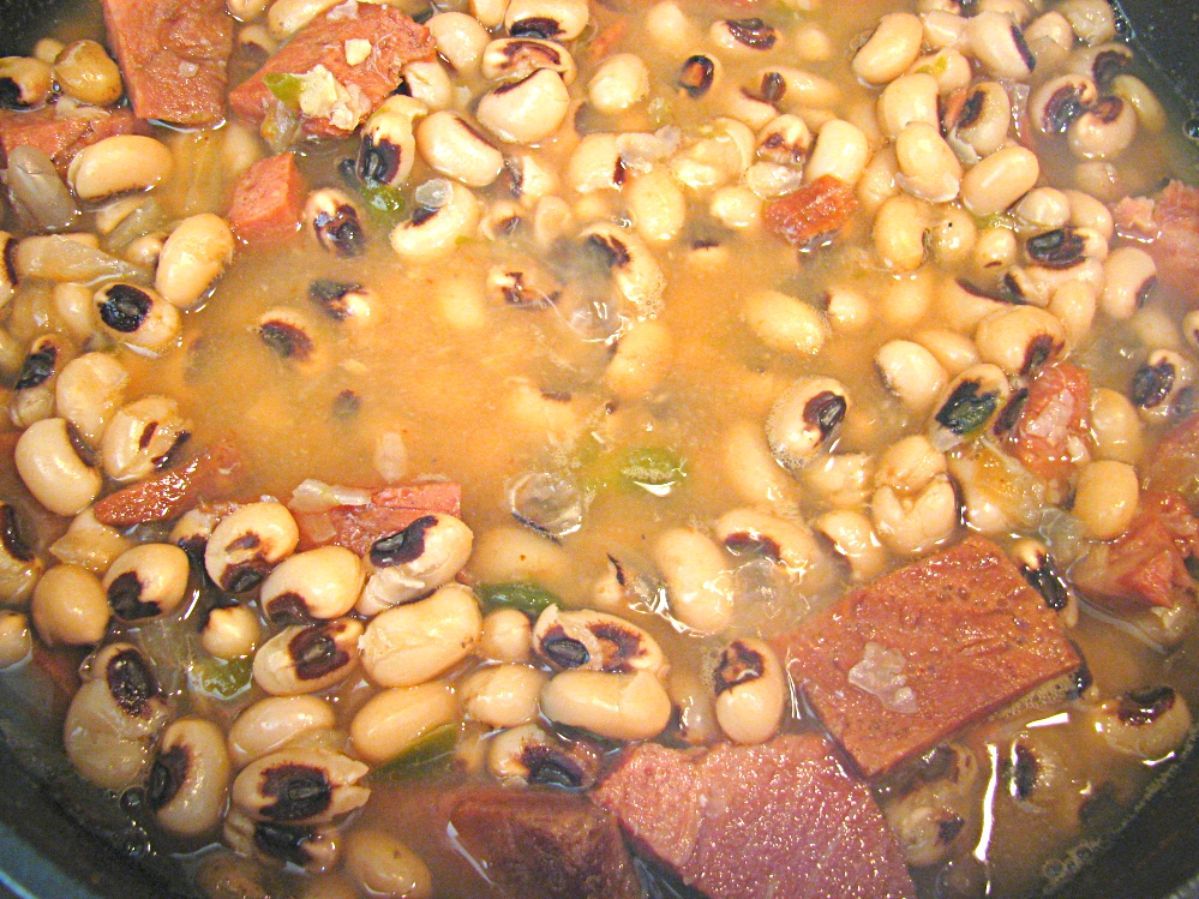
Southern black-eyed peas, a cure for superstitious New Year folks
1 smoked ham hock or ham bone
4 cups water
1/2 pound bacon, cut into 1-inch pieces
1 large onion, chopped
1 large bell pepper, chopped
1 stalk celery, chopped
2 large cloves garlic, minced
1 pound smoked sausage links, cut into 1/2-inch pieces
3 packages (16 ounces each) frozen black-eyed peas
2 medium bay leaves
1 teaspoon black pepper
1 can (14.5 ounces) Rotel Extra Hot tomatoes and chilies
1 tablespoon Cajun seasoning
1/8 teaspoon dried thyme
Cooked white rice, for serving
Chopped green onions, for serving
In a large saucepot, simmer the ham hock and water for an hour, or until the meat is falling off the bone. Strain the liquid and reserve the stock. Pull the meat from the bone and add it to the stock.
Meanwhile, in a large stockpot, fry the bacon until brown. Remove the bacon and reserve it. Add the onion, bell pepper, celery and garlic to the drippings and cook until the onion is translucent. Add the reserved ham stock and simmer on very low heat while you prepare the sausage.
In the saucepan used earlier, place the sausage and 1/2 cup of water. Simmer for 15 minutes to draw out the fat. Remove the sausage and add it to the stockpot. Discard the fat stock.
Add the Rotel to the stockpot, bring to a boil and simmer for a few minutes. Then add the peas, bay leaves, black pepper, Cajun seasoning and thyme. The liquid should just cover the peas. If it does not, add water. Simmer on low for 1 1/2 hours, stirring often to prevent sticking, until the peas are fully cooked and the stock is thick. You may need to remove a cup of peas and mash them to get a thick consistency.
Chop some of the reserved bacon and add it to the peas toward the end of cooking. Serve over white rice and top with chopped green onions.
Willie's Collards and Greens
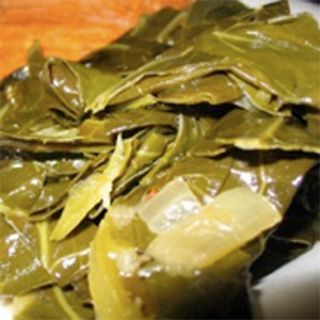
This is how she made greens for us many times during the year. The pot likker is a plus!
4 to 6 bunches fresh collards
3 to 4 leaves mustard greens
2 smoked ham hocks
6 slices bacon
1 large onion, chopped
1 to 2 tablespoons seasoning salt
1 to 2 teaspoons sugar
1/2 teaspoon black pepper
Clean the greens thoroughly to remove grit by washing several times in cold water. Remove the tougher stalks as needed. Chop the greens into 1 to 2 inch squares.
In a large stockpot, fry the bacon until the fat is rendered. Remove the bacon and set it aside. Add 7 to 8 cups of water to the drippings and bring to a boil. Add the ham hocks, onion, seasoning salt, sugar and pepper. Return to a boil and simmer for 10 to 15 minutes. Add the greens and boil for another 15 minutes. Check the water level and continue simmering on medium-low for 3 to 4 hours. Before serving, add more seasoning salt if needed and stir in the bacon.
Note: I like to add a jalapeño or two and a splash of red wine vinegar. I also cook turnip greens this way. Be sure to soak up the likker with cornbread.
Recipes & Posts